


TDI Advanced Wreck
TDI Advanced Wreck at a glance
- TDI advanced wreck at a glance:
- Prerequisites
- Min Age 18
- Proof of 50 logged dives
- Recreational Wreck Diver
In addition to TDI standards, Big Blue Tech requires divers to have Sidemount or Twinset training and be a certified Decompression Diver.
- 4-5 Days - 8 Dives
- Cert Level: Dark Zone Wreck
- All course equipment, gases and dives included
TDI Advanced Wreck Diver: Enter the Dark Zone
In the overhead dark zone, where the comfort of a direct vertical ascent disappears, it is your training and discipline alone that ensure your safety. The lure of sunken ships is one of diving’s greatest odysseys—to step inside historical structures where few human beings have ever set foot is an unparalleled adventure.
The TDI Advanced Wreck Diver course is the ultimate next step for any certified wreck diver looking to transition into full, technical overhead environments. Over this intensive 5-day course, you will abandon recreational limitations and master the advanced logistics, gas management, and team safety protocols required to plan and execute complex wreck penetration dives.
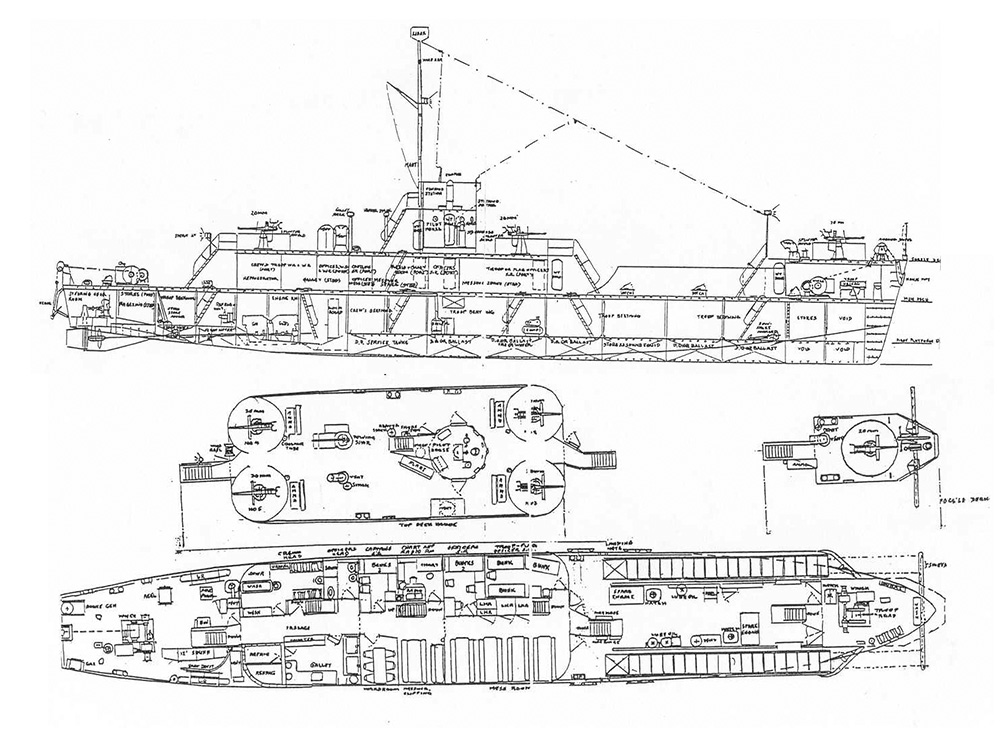
Your Classroom: The HTMS Sattakut or 313
All tactical in-water training for this course takes place on the historic HTMS Sattakut or 313, located just West of the Big Blue Tech facilities.
With a maximum depth of 30 meters, this World War II-era troop carrier serves as the perfect real-world platform for technical training. Over five days, you will dive deep into her history and her hull, quite literally swimming through the past.
What You Will Master
Advanced wreck penetration leaves no room for error. Under the direct mentorship of our technical instructors, you will master:
Advanced Gas Logistics: Implementing strict gas matching, Rule of Thirds/Sixths, and independent turn-pressure calculations for technical teams.
Complex Guideline Mechanics: Perfecting precision line laying, lost-line drills, silt-out navigation, and managing primary, backup, and jump reels in confined, overhead layouts.
Propulsion & Anti-Silting: Fine-tuning specialized anti-silting kicks (modified frog and shuffle kicks) to navigate restrictive corridors without compromising visibility.
Emergency Protocol Execution: Managing catastrophic equipment failures, light failures, gas sharing, and tactile team communication while completely inside the overhead zone.
Flexible Online Learning
Get the heavy overhead theory out of the way before you pack your bags. With the TDI eLearning platform, you can complete all of your technical academics online on your own schedule. Once you arrive at Big Blue Tech, we will review your theory, adjust your gear configurations, and head straight to the boat to begin five days of elite technical exploration.
TDI Advanced Wreck gallery


Itinerary
Day 1: Advanced Overhead Theory & Line Fundamentals
Your journey into the technical overhead environment begins with a structured and demanding first day, designed to bridge the gap between open water and the rigorous demands of the dark zone.
Morning: Technical Overhead Theory & Analytics
We kick off the morning by meeting your Big Blue Tech Instructor at our beachside restaurant. Over a coffee, we’ll complete the initial paperwork and dive straight into your instructor-led academics—a highly detailed classroom session that sets the standard for every morning of the course.
Today’s intensive theoretical modules cover:
Hazards of Technical Wreck Diving: Identifying structural collapse risks, specialized entanglement hazards, and advanced psychological factors.
Overhead Line Mechanics: The physics and protocols of laying continuous guidelines through complex metal structures.
Contingency & Emergency Planning: Formulating redundant gas schedules, exit strategies, and team-based emergency protocols.
Technical Equipment Requirements: Streamlining your harness configuration, isolating regulators, and optimizing redundant lighting configurations.
Day 2: Advanced Land Drills & Open Water Transition
Day 2 builds directly on your initial skills, moving from shallow mechanics to real-world application. Today, we focus heavily on pre-dive accountability, technical team drills, and transitioning your line work to the marine environment.
Morning: Dive Planning & Precision Land Drills
We kick off the morning at the beachfront restaurant to continue your technical academics and make any necessary adjustments to your equipment harness based on yesterday’s sessions.
Before heading to the boat, the team transitions to critical practical and dry-land drills:
Primary Line Laying: Perfecting the physical mechanics of team line deployments, tie-offs, and wrap placements on land.
Technical Dive Planning: Calculating strict gas matching schedules, Rule of Thirds/Sixths boundaries, and runtime protocols.
Gas Analysis: Personally testing and logging all cylinder contents, confirming oxygen percentages, and labeling your maximum operating depths (MOD) if executing decompression profiles.
Afternoon: Open Water Skills Application SHallow skills
Following a lunch break, we board the boat to put your dry drills into practice in the open ocean. These dives focus on mastering your technical safety protocols directly along the exterior of the wreck site.
Under the direct evaluation of your instructor, you will execute:
Real-World Guideline Mechanics: Laying and retrieving primary lines along an actual structure while maintaining absolute depth control.
Mid-Water Buoyancy & Position Control: Flawlessly maintaining horizontal trim and using specialized anti-silting propulsion in the water column while your hands are busy managing reels.
In-Water Emergency Simulations: Performing full valve isolation drills, team gas sharing, and simulated blacked-out mask exits along the line in an open water environment.
Evening: Debrief & Strategy Session
Back on land, we head to the restaurant to conduct a comprehensive tactical review of the afternoon’s activities. With a cold drink in hand, your instructor will debrief your team’s performance, refine your line handling, and map out the dive plans for your upcoming penetration phases.
Day 3: Advanced Land Drills & Open Water Transition
Day 2 builds directly on your initial skills, moving from shallow mechanics to real-world application. Today, we focus heavily on pre-dive accountability, technical team drills, and transitioning your line work to the marine environment.
Morning: Dive Planning & Precision Land Drills
We kick off the morning at the beachfront restaurant to continue your technical academics and make any necessary adjustments to your equipment harness based on yesterday’s sessions.
Before heading to the boat, the team transitions to critical practical and dry-land drills:
Primary Line Laying: Perfecting the physical mechanics of team line deployments, tie-offs, and wrap placements on land.
Technical Dive Planning: Calculating strict gas matching schedules, Rule of Thirds/Sixths boundaries, and runtime protocols.
Gas Analysis: Personally testing and logging all cylinder contents, confirming oxygen percentages, and labeling your maximum operating depths (MOD) if executing decompression profiles.
Afternoon: Open Water Skills Application (Dives 1 & 2)
Following a lunch break, we board the boat to put your dry drills into practice in the open ocean. These dives focus on mastering your technical safety protocols directly along the exterior of the wreck site.
Under the direct evaluation of your instructor, you will execute:
Real-World Guideline Mechanics: Laying and retrieving primary lines along an actual structure while maintaining absolute depth control.
Mid-Water Buoyancy & Position Control: Flawlessly maintaining horizontal trim and using specialized anti-silting propulsion in the water column while your hands are busy managing reels.
In-Water Emergency Simulations: Performing full valve isolation drills, team gas sharing, and simulated blacked-out mask exits along the line in an open water environment.
Evening: Debrief & Strategy Session
Back on land, we head to the Tech shack to conduct a comprehensive tactical review of the afternoon’s activities. With a cold drink in hand, your instructor will debrief your team’s performance, refine your line handling, and map out the dive plans for your upcoming penetration phases.
Day 4: Technical Final Exam & Advanced Emergency Navigation
Day 4 marks a major shift in your technical training. This morning you will validate your theoretical knowledge on paper, before heading back to the wreck to master the most critical emergency response protocols used in technical overhead diving.
Morning: Final Exam & Advanced Contingency Land Drills
We start the morning at the restaurant by wrapping up your technical classroom modules and completing the TDI Advanced Wreck Final Exam.
Once the academics are officially signed off, the team shifts directly into highly specialized dry-land practical drills, building the precise muscle memory required to handle complex emergency scenarios inside an overhead environment:
Lost Line Protocols: Learning how to systematically deploy a search reel to relocate a primary guideline in total visibility loss or a silt-out.
Lost Diver Procedures: Mastering the team communication, search grid mechanics, and light-signaling protocols used to locate a missing teammate inside a structure.
Afternoon: Technical Dives 4 & 5 (The Emergency Scenarios)
After lunch, we board the boat and head back out to the HTMS Sattakut. Today’s dives transition your morning land drills into real-world underwater problem-solving along and within the wreck structure.
Under the close evaluation of your instructor, your team will execute:
In-Water Lost Line Drills: Simulating a complete disconnection from your exit line and executing a disciplined, reel-assisted search to re-establish a continuous guideline to the surface.
In-Water Lost Diver Drills: Managing a high-stress teammate separation scenario using precise, coordinated team search search patterns without compromising your own gas rules or exit routes.
Overhead Mechanics Validation: Continuing to refine your absolute depth control, horizontal trim, and anti-silting propulsion while managing these complex, task-loaded scenarios.
Evening: Sunsets & Tactical Analysis
Back on land, we return to the beachfront bar to review the day’s training. While admiring the Koh Tao sunset, your instructor will conduct a comprehensive tactical debrief, analyzing your team’s communication, reaction times, and emergency management to get you fully prepped for the final graduation days.
This is a flexible day that can be utilised as required e.g. as an additional training day or to gain further experience.
FAQs
What can I expect to learn about?
This is an intensive course and students arrive at different stages of their dive career so our instructors tailor each course, below are some of the main topics we cover.
- Use of advanced wreck diving equipment
- Wreck penetration procedures
- Equipment selection
- Guideline use, deployment, following, retrieval
- Team awareness and communication
- Emergency procedures for equipment failures, catastrophic gas loss, omitted decompression, navigational errors, entrapment/entanglement, injured/unconscious diver, loss of visibility, injured/unconscious diver.
Will I be able to dive this certification with Big Blue Tech after the course?
Absolutely, We encourage all of our newly certified students to get back in the water and enjoy their new certifications. With a healthy number of Technical divers on the staff and a dedicated Tech boat, we offer unequaled Tech fun diving opportunities here on Koh Tao.
What's included (or not) in the course?
Included
All materials and certification costs on successful completion
Sidemount or Twinset (Regs, Harness & Tanks)
Fins (Students are required to have boots if they wish to use our open heeled tech fins)
Exposure suit
- Back up mask / light / bottom timer / cutting device
SMB and primary line
Pri,mary penetration reel and safety reel
Not Included – Divers taking a course at this level should have some of their own primary equipment (any of which can be purchased on arrival):
Primary Mask
Primary Dive computer
Wrist slate
Boots (If you wish to use our open heeled tech fins)
Compass
Primary cutting device
Primary Light
Cookies and directional arrows
Can I view the TDI Standards for this course online?
 Adv Wreck standards
OK, let's do this... How do I book?
Just hit the button, or if you have questions, we're here to help- quickest way to contact us is using the Facebook button at the bottom :)